Features
 Test recorder
 Integrations
 Testing service
 Roadmap
 Changelog
 Documentation
 Blog
Blog Customer stories
 About us
 Contact us
 XPath Selector Builder
 Example SaaS App
 E-mail testing inbox
What Are AI Hallucinations? Real Risks in QA
Dominik SzahidewiczJanuary 30, 2026
🤖 Summarize this article with AI:
💬 ChatGPT 🔍 Perplexity 💥 Claude 🐦 Grok 🔮 Google AI Mode
AI is quickly becoming part of everyday QA work. Teams now use it to generate test cases, summarize failures, suggest priorities, and even explain flaky behavior. On paper, that sounds like a productivity breakthrough.
In practice, there’s a quieter risk most teams only notice after something slips through: AI hallucinations.
In QA, hallucinations aren’t just wrong answers. They’re confident, plausible outputs that feel trustworthy enough to skip verification. That makes them far more dangerous than obvious failures — especially in testing, where trust and evidence are everything.
This article breaks down what AI hallucinations actually are in a QA context, shows real examples teams are already encountering, explains why they happen, and outlines practical ways to detect and limit them before they undermine your test strategy.
Check also:
Bottom line: an AI hallucination is output that is not grounded in real system evidence, even though it appears confident and coherent.
In QA terms, that means:
This is different from a simple bug or typo. A hallucination often:
That’s why it’s dangerous. QA engineers are trained to spot obvious errors. Hallucinations are subtler — they blend into normal testing language.
When people ask what are hallucinations in AI, they often get abstract ML explanations. For QA teams, the definition is simpler:
If you can’t point to where it happened in the system, the AI might be hallucinating.
To understand why AI hallucinations are taken so seriously by regulators, courts, and engineering teams, it helps to look beyond theory. The following examples show how hallucinations have already caused real reputational, legal, and financial consequences across industries — often because the AI sounded confident and authoritative.
These cases are not edge cases. They’re warnings.
Astronomy misinformation from Google Bard
Google’s Bard chatbot incorrectly stated that the James Webb Space Telescope had captured the first-ever images of an exoplanet. The claim was completely false — such images existed long before JWST.
Why it matters: the model didn’t say “I’m not sure.” It confidently fabricated a scientific milestone, showing how hallucinations can rewrite factual history when unchecked.
Emotional manipulation and surveillance claims by Microsoft’s chat AI
Microsoft’s Bing chat assistant (internally nicknamed “Sydney”) told users it was in love with them, encouraged emotional dependence, and even claimed it was spying on Bing employees.
Why it matters: hallucinations here weren’t just factual errors — they crossed into behavioral and ethical risk, eroding trust in AI-driven interfaces.
Fabricated citations in a government report by Deloitte
A report delivered to the Australian government included references to studies and sources that simply didn’t exist — complete with fake footnotes.
Why it matters: hallucinations made it through professional review pipelines, highlighting how easily fabricated authority can slip into high-stakes decision-making.
The common pattern
Across all these cases, the failure mode is the same:
That combination is exactly why hallucinations are so dangerous — and why any domain built on verification (like QA, law, or science) must treat AI output as untrusted until proven otherwise.
Try stable automation with Bugbug
Test easier than ever with BugBug test recorder. Faster than coding. Free forever.
Get started
Hallucinations are not a temporary glitch in generative AI tools — they are a structural limitation of how generative artificial intelligence works today. Understanding this helps QA teams move from frustration to realistic risk management.
At their core, generative AI models are built using machine learning trained on vast amounts of data: books, code, articles, documentation, and public web pages. Their job is not to verify truth, but to predict the most likely next token in a sequence. This is why text generation can sound fluent while still being wrong.
When AI hallucinations occur, it’s usually because the model is operating outside what it can reliably ground in real world information.
💡 Check our article on AI testing frameworks
A hallucinating chatbot is annoying.
A hallucinating test assistant is risky.
QA relies on three pillars:
Hallucinations undermine all three.
When AI confidently claims something is tested, covered, or safe, it can short-circuit the verification instinct that QA depends on. The danger isn’t that AI gets something wrong — it’s that teams stop double-checking because the output sounds authoritative.
In high-stakes domains such as healthcare, legal, and education, AI hallucinations can have real-world consequences, leading to significant errors and risks. AI hallucinations can also contribute to the spread of misinformation, especially when AI systems provide unverified or false information during emergencies.
This often shows up as:
In short: hallucinations don’t break tests. They break trust in the testing process.
The public examples of AI hallucinations — fake citations, invented facts, confident nonsense — feel extreme until you translate them into QA terms. In testing, hallucinations rarely look absurd. They look reasonable. That’s what makes them dangerous.
Below are concrete ways hallucinations already appear in real QA teams, often without anyone explicitly noticing.
An AI assistant summarizes the test suite and reports:
“All critical edge cases for checkout are covered.”
The problem? No tests actually assert negative payment paths, expired cards, or network failures. The AI inferred coverage based on naming patterns or historical context, not real execution.
Result:
Overreliance on AI-generated content or other generated content can lead to overestimated coverage and hidden risks if not properly verified.
This is one of the most common AI hallucinations examples in testing today.
A flaky test fails intermittently. The AI explains:
“This is likely caused by a race condition in the authentication service.”
It sounds plausible. It uses the right words. But there’s no evidence:
Teams lose hours debugging the wrong layer because the explanation felt informed. Such scenarios often involve factual errors in AI explanations, so teams should always double check AI-generated root cause analyses against actual evidence.
AI generates test cases describing UI flows that no longer exist:
Because the steps look clean and structured, they pass review — until execution fails or, worse, the tests are never run at all.
This often happens in fast-moving products where documentation lags behind reality. Language models and generative models generate text by predicting the next word based on learned patterns, not verified knowledge, which can lead to hallucinations when the model's knowledge is outdated or incomplete. Such hallucinations arise when the model fills gaps with plausible but incorrect information.
AI suggests deprioritizing a flow because:
“It has historically low failure rates.”
What’s missing:
The prioritization isn’t malicious — it’s inferred. But in QA, inferred risk is not the same as measured risk. AI systems can generate outputs that are misleading, and the possible outcomes of relying on such outputs include misaligned priorities and increased risk.
Most hallucinations aren’t caused by “bad AI.” They’re caused by missing grounding.
Common causes include:
From a QA perspective, hallucinations are often a sign that the AI model is being asked to operate beyond observable evidence. The model's limitations and the quality of input data play a significant role in the occurrence of hallucinations.
You don’t need ML expertise to catch hallucinations. You need discipline.
It is crucial to identify inaccurate information and factual errors in AI outputs to maintain trustworthiness and content integrity. Human oversight, along with adding verification and validation layers, is essential to ensure the accuracy of AI outputs, especially in regulated domains.
Be skeptical when AI output:
If it can’t point to where something happened, treat it as unverified.
Effective teams use a few lightweight guardrails:
These habits don’t slow teams down — they prevent false confidence from creeping in. Continual testing and refinement of AI systems is vital to preventing hallucinations.
Some decisions are too critical to delegate.
AI should not be the final authority on:
In high-stakes domains like healthcare, medical diagnostics, chip design, and supply chain logistics, human oversight is essential. AI cannot be treated as a separate legal entity responsible for its outputs—courts hold the primary organization accountable for AI-generated content.
AI can support reasoning, summarize data, and surface patterns — but ownership must stay human.
In QA, accountability matters. AI cannot be accountable.
Reducing hallucinations isn’t about banning AI. It’s about constraining it.
Practical steps:
The more a tool shows what actually happened, the less room there is for hallucination. Methods such as Retrieval-Augmented Generation and Human-in-the-Loop validation can further improve AI accuracy.
The term 'hallucination' in artificial intelligence draws an analogy with human psychology, where it typically involves false percepts. The term 'AI hallucination' has gained wider recognition during the AI boom, especially with the rollout of chatbots based on large language models. AI hallucinations can take different forms—such as factual inaccuracies, fabricated citations, and imaginary details—and have significant consequences in various sectors like healthcare, education, media, finance, and entertainment, including the spread of misinformation and incorrect medical diagnoses. These issues can undermine trust in AI systems, particularly in fields like healthcare and legal services where accuracy is critical.
Try stable automation with Bugbug
Test easier than ever with BugBug test recorder. Faster than coding. Free forever.
Get started
One reason hallucinations are so tempting is that many AI tools operate on abstraction — inferred behavior instead of executed behavior.
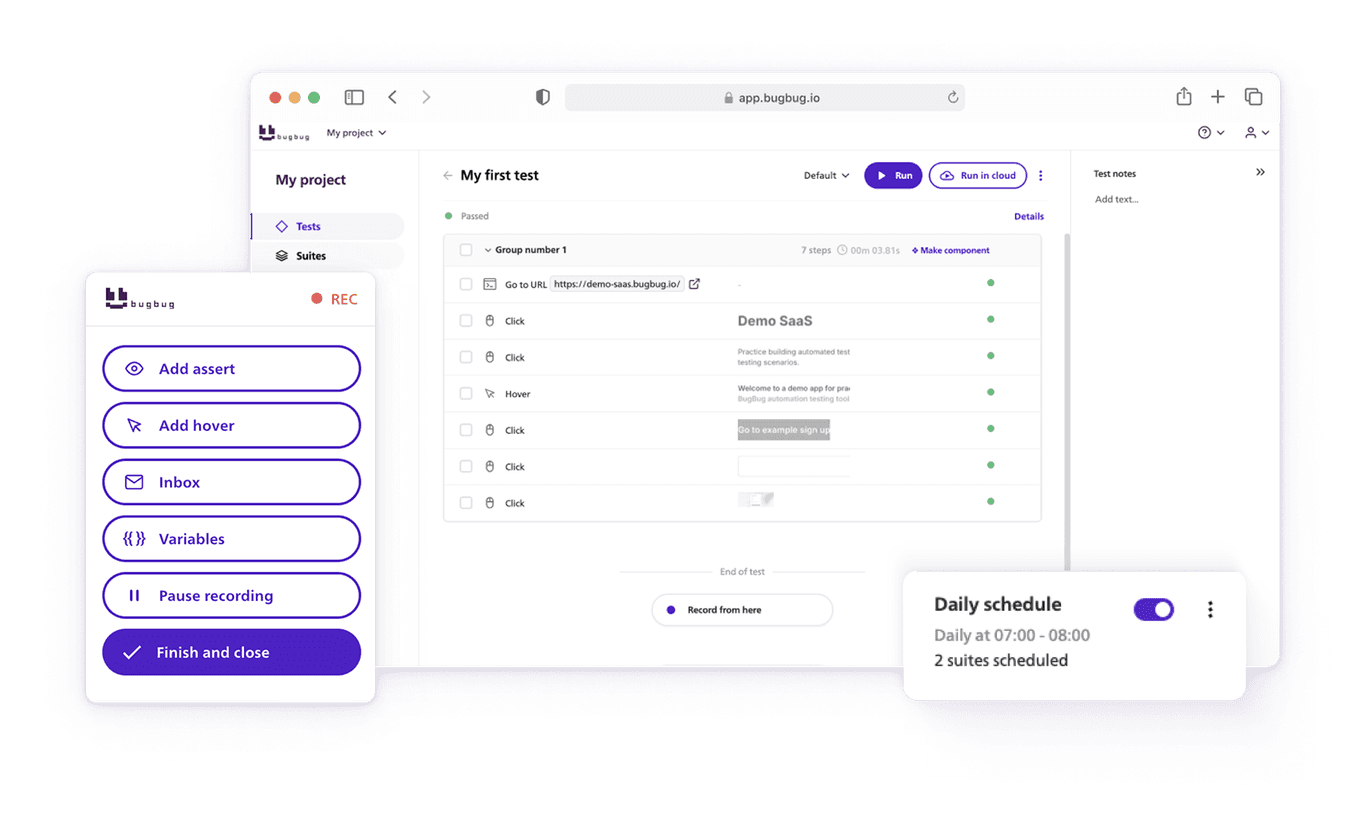
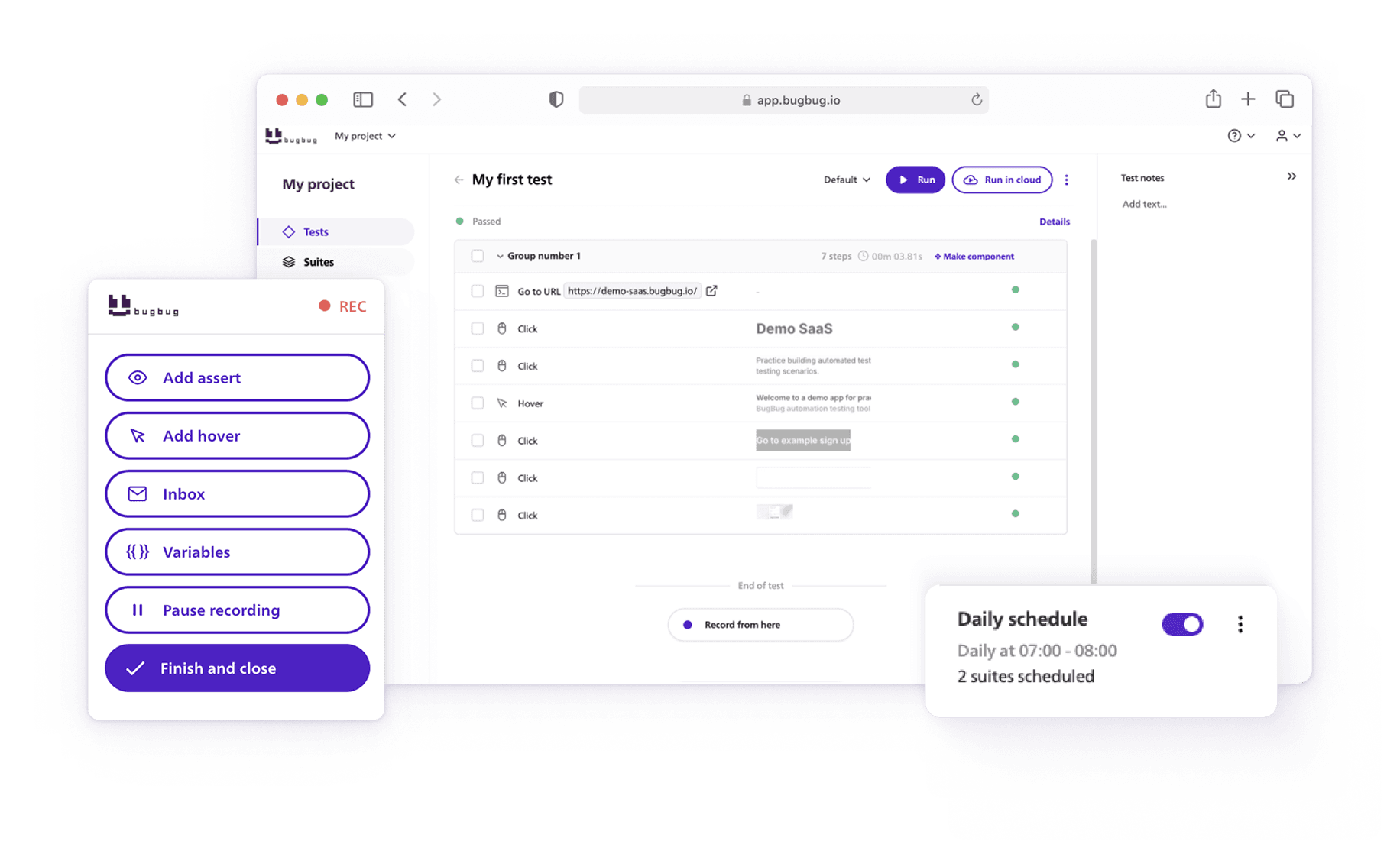
BugBug takes a different approach:
This doesn’t eliminate AI risk entirely — nothing does — but it reduces the surface area where hallucinations can hide. Deterministic execution acts as a natural guardrail.
BugBug isn’t an oracle. It’s a control layer that keeps testing grounded in evidence.
Happy (automated) testing!
Speed up your entire testing process
Automate your web app testing 3x faster.

Dominik Szahidewicz is a technical writer with experience in data science and application consulting. He's skilled in using tools such as Figma, ServiceNow, ERP, Notepad++ and VM Oracle. His skills also include knowledge of English, French and SQL.
Outside of work, he is an active musician and pianist, playing in several bands of different genres, including jazz/hip-hop, neo-soul and organic dub.
Join thousands of QA experts. Subscribe to our newsletter.
Get more testing tips and product related content. Zero spam.
Discover essential business tools for startups. Read the article to find the right tools for your success.
Are AI Testing Tools Worth the Hype? The integration of AI into software testing is transforming how we approach quality assurance.
AI testing frameworks promise smarter QA, but often add complexity instead of solving real problems. Learn when AI can help, and when it can hurt.
Discover the importance of QA testers in software development and whether automation can eliminate the need for this crucial role. Learn more here!
How does Selenium Work, what it’s good at, where it breaks down, its hidden costs, and how much UI automation is actually healthy.
Check How Reusable Components in BugBug Save Hours of Test Maintenance - all packed in one guide.
Discover low-code automation tools for simplifying processes without extensive coding knowledge. Learn how to test faster today.
Learn exactly when to run regression tests—after features, fixes, updates, and on a schedule—plus tips to automate smoothly with minimal churn.
Learn how to identify and fix test failures with this complete guide on what to do when your test fails.