Features
 Test recorder
 Integrations
 Testing service
 Roadmap
 Changelog
 Documentation
 Blog
Blog Customer stories
 About us
 Contact us
 XPath Selector Builder
 Example SaaS App
 E-mail testing inbox

🤖 Summarize this article with AI:
💬 ChatGPT 🔍 Perplexity 💥 Claude 🐦 Grok 🔮 Google AI Mode
AI testing services promise a big leap forward from traditional, script-heavy QA. Instead of brittle automation and manual checks, they introduce adaptive Quality Engineering (QE) powered by artificial intelligence (AI) and machine learning (ML). AI testing requires novel approaches to quality that combine traditional testing methods with new data science expertise, and specialized skills are often needed to effectively validate AI systems.
But here’s the real question most QA teams and founders should ask: do you actually need them—or will they just add cost and complexity? In today’s rapidly evolving market, organizations must adopt AI and continuously innovate to stay competitive. AI testing must address the unique challenges posed by AI systems, including unpredictability and the need for continuous evolution.
Let’s break it down clearly and practically.
🎯 TL;DR - AI Testing Services
- AI testing services extend traditional QA with self-healing automation, predictive analytics, and no/low-code test creation, but they add cost and complexity.
- They make the most sense for teams shipping AI-driven features, maintaining large flaky test suites, or operating in regulated, high-risk domains.
- AI-powered Quality Engineering (QE) focuses on speeding up and stabilizing “normal” software testing, not replacing human testers.
- Testing AI systems themselves (LLMs, GenAI, ML models) requires specialized skills like bias detection, hallucination testing, and model behavior monitoring.
- For many teams, especially startups and SaaS products, disciplined, deterministic automation often delivers better ROI than AI-heavy testing services.
Check also:
What Are AI Testing Services—Really?
AI-powered testing tools and platforms go beyond traditional methods by offering features like self-healing capabilities, predictive analytics, and no-code test automation. These advanced testing tools leverage artificial intelligence to automate test creation, maintenance, and execution, making software testing more efficient and reliable.
AI-Assisted Testing Services
- Use machine learning and AI algorithms to analyze test data, user flows, and application behavior.
- Identify patterns, anomalies, and potential bugs that may be missed by manual testing.
- Provide real-time insights and fixes, empowering teams to focus on innovation.
- Automated tests and test automation reduce manual effort and improve reliability.
AI testing tools help teams handle test maintenance, which is often the most time-consuming part of the automated testing process.
AI-driven tools can reduce testing cycle times by up to 50%, enabling faster release frequencies, and can reduce quality assurance expenses by 50–70% due to automation of routine tasks. No-code solutions make test automation accessible to non-developers, allowing broader team participation. Algorithms analyze requirements and user stories to automatically generate comprehensive test cases, including complex edge cases. AI tools adapt to UI changes automatically, reducing the need for manual script maintenance by up to 70–85%. These tools also improve model accuracy by identifying and mitigating biases in data. Quality assurance, reliability, and confidence are critical benefits of AI-powered testing tools, ensuring robust and dependable software releases.
1. AI-Powered Quality Engineering (QE)
This is about using AI to improve how you test “normal” software.
Typical capabilities include:
- Self-healing test scripts that adapt when UI locators or workflows change
- Predictive defect detection, using historical data to flag risky code paths
- Automated test generation from requirements, user flows, or wireframes
- Codeless / low-code authoring, enabling non-developers to build tests
- AI-powered test automation and automated tests that leverage predictive analytics and self-healing capabilities to accelerate test creation, maintenance, and execution
No-code solutions make test automation accessible to non-developers, allowing teams to quickly build and maintain tests without programming knowledge.
AI tools adapt to UI changes automatically, reducing the need for manual script maintenance by up to 70–85%.
AI-driven tools can reduce testing cycle times by up to 50%, enable faster release frequencies, and reduce quality assurance expenses by 50–70% due to automation of routine tasks.
AI testing tools can help teams handle test maintenance, which is often the most time-consuming part of the automated testing process.
The goal is speed, stability, and reduced maintenance—not replacing testers.
2. QE for AI Systems
This is about testing AI itself.
If you’re building or integrating:
- Generative AI features
- Large Language Models (LLMs)
- Recommendation engines or chatbots
…you need specialized validation for:
- Bias detection and fairness (Bias detection is a critical challenge in AI testing, as flawed data can lead to inaccuracies and reflect historical or societal biases.)
- Model drift over time (AI systems can experience drifting precision when exposed to new data, necessitating ongoing testing and optimization.)
- Hallucinations and unsafe outputs
- Prompt robustness and response accuracy
- Model behavior analysis (Understanding and evaluating model behavior is essential to ensure accuracy, fairness, and stability.)
- Edge case management (Identifying and testing edge cases improves model performance and software quality.)
- Model optimization (Model optimization involves fine-tuning AI models through rigorous testing to enhance performance and stability.)
- Robustness testing (Robustness testing evaluates the model's ability to handle edge cases, noisy data, or adversarial inputs.)
- Data validation and preprocessing testing (Ensuring training and test data is representative, clean, and unbiased is crucial.)
- Bias and error detection (AI testing should include bias and error detection to ensure model accuracy and fairness.)
- Specialized skills (Testing AI products requires specialized skills, such as data science expertise and understanding of model behavior, to validate AI systems and detect biases.)
Human oversight is necessary in AI testing to validate processes and ensure that AI systems function correctly and ethically.
Compliance with regulations, data privacy, and security testing are essential in AI testing to ensure ethical and responsible AI deployment, especially when handling sensitive data.
Traditional automation simply isn’t designed for this.
💡 Read also: AI Hallucinations in QA Testing
Core Capabilities You’re Actually Paying For
Most AI testing providers differentiate themselves with accelerators and agents:
- Self-healing automation
Tests don’t fail just because a button ID changed. The system adapts automatically. It does not solve conceptual flakiness, timing issues, or poor test architecture. - Shift-left testing
Tests are generated from wireframes or requirements, so QA starts before code stabilizes. - Agentic AI orchestration
Autonomous agents handle focused tasks like accessibility (a11y), visual regression, or test deduplication. - AI ethics and safety testing
Includes guardrail validation, adversarial testing (red teaming), and compliance audits. - Proprietary tools and AI testing solutions
Providers leverage proprietary tools and advanced AI tooling to improve test management, maintain robust test suites, and enhance overall software quality. These solutions help avoid common pitfalls, reduce researcher bias, and improve testing accuracy for AI testing projects and AI projects. - QA partner for tailored solutions
A reliable QA partner can help manage complex AI testing projects, deliver tailored solutions for industry-specific needs, and ensure the reliability, accuracy, and fairness of AI systems. They validate models to ensure they operate as intended in real-world scenarios, help identify human errors, prevent negative publicity due to perceived bias, and ensure smooth integration of AI systems with existing software and data infrastructures. - Continuous monitoring and performance evaluation
AI testing services monitor CI/CD pipelines in real-time to ensure updates adhere to regulatory standards, proactively identify potential failure points by simulating diverse user scenarios, and evaluate model performance using precision, recall, F1-score, and AUC-ROC metrics. Continuous observability monitors interactions in production to ensure long-term reliability of AI models. - Enhanced reliability and faster time-to-market
AI reduces human error, ensures consistent results across various scenarios, and enhances product stability. Predictive analytics identify potential issues and defects early in the development cycle, enabling faster time-to-market without sacrificing quality or performance.
When AI Testing Services Make Sense
1. Your Automation Is Breaking Faster Than You Can Fix It
If flaky tests and locator maintenance dominate your sprints, it's important to recognize that test maintenance is often the most time-consuming part of the automated testing process for software teams. Self-healing automation and AI tooling can meaningfully reduce the effort and cost associated with test maintenance, helping software teams automate updates and minimize manual intervention.
2. You’re Shipping AI-Driven Features
LLMs, GenAI copilots, or ML-based decision systems require:
- Bias testing
- Hallucination detection
- Ongoing behavioral monitoring
- Evaluation of model behavior under various conditions
- Handling of edge cases to ensure reliability
Specialized testing strategies, such as robustness testing, are essential to evaluate the model's ability to handle edge cases, noisy data, or adversarial inputs and to ensure AI systems perform reliably.
This goes beyond classic pass/fail assertions.
3. You Operate in Regulated or High-Risk Domains
Finance, healthcare, or enterprise SaaS teams often need:
- AI governance
- Explainability checks
- Security-focused red teaming
- Regulatory compliance to ensure AI systems adhere to industry-specific regulations and standards
- Data privacy measures to protect sensitive information and support ethical operation
- Security testing to identify vulnerabilities and meet regulatory and ethical requirements
Using proprietary tools is crucial for ensuring compliance, data privacy, and robust security in AI testing, providing tailored solutions for regulated and high-risk environments.
4. QA Is the Bottleneck in Fast Release Cycles
AI-assisted test creation and intelligent test selection can significantly accelerate feedback loops—if your process is already mature, helping teams save time and improve performance. AI-driven tools can reduce testing cycle times by up to 50%, enabling teams to ship faster and deliver higher quality releases.
When You Probably Don’t
AI testing services are often overkill if:
- You’re still struggling with basic test coverage
- Your UI changes weekly with no stable flows
- Your team lacks ownership of test design and quality strategy
In those cases, simpler, reliable automation usually delivers better ROI.
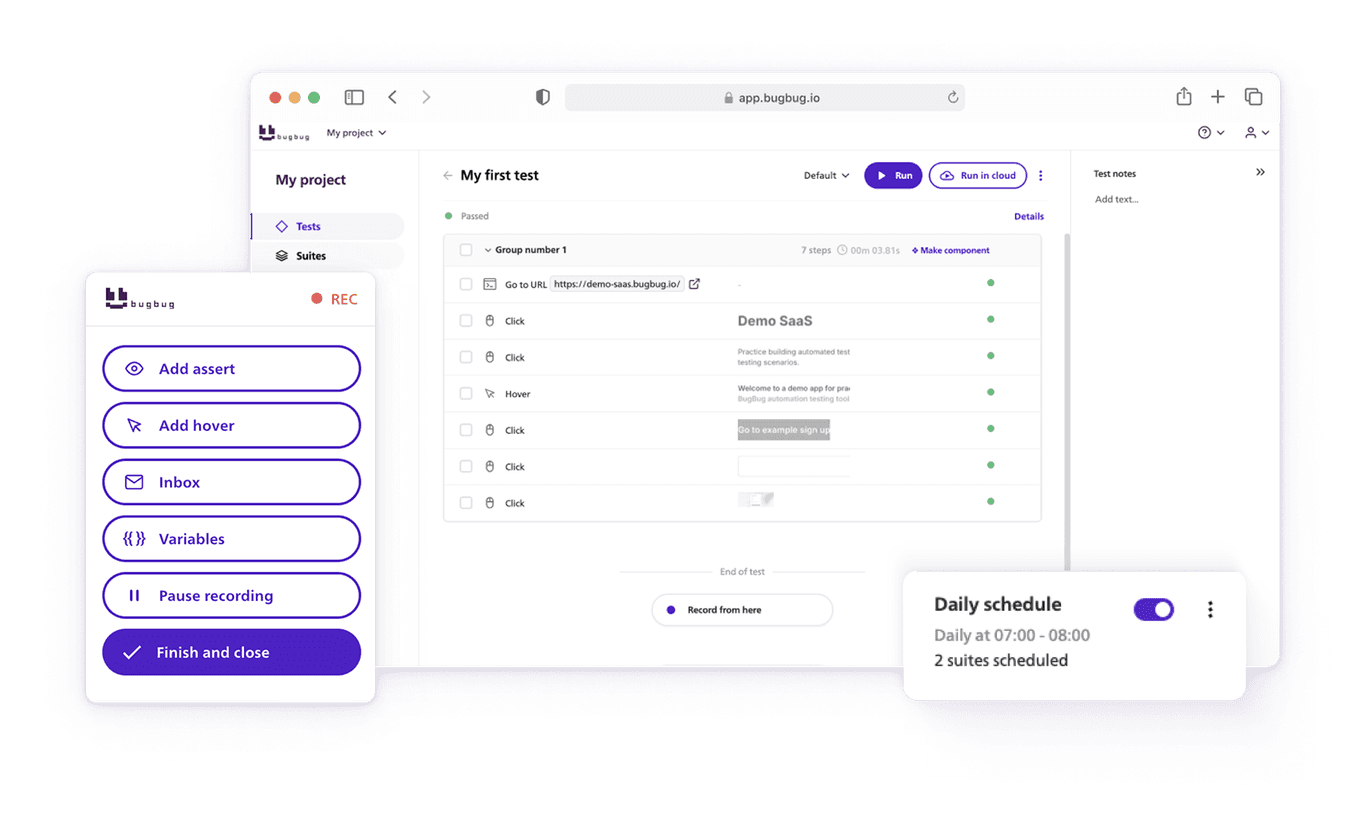
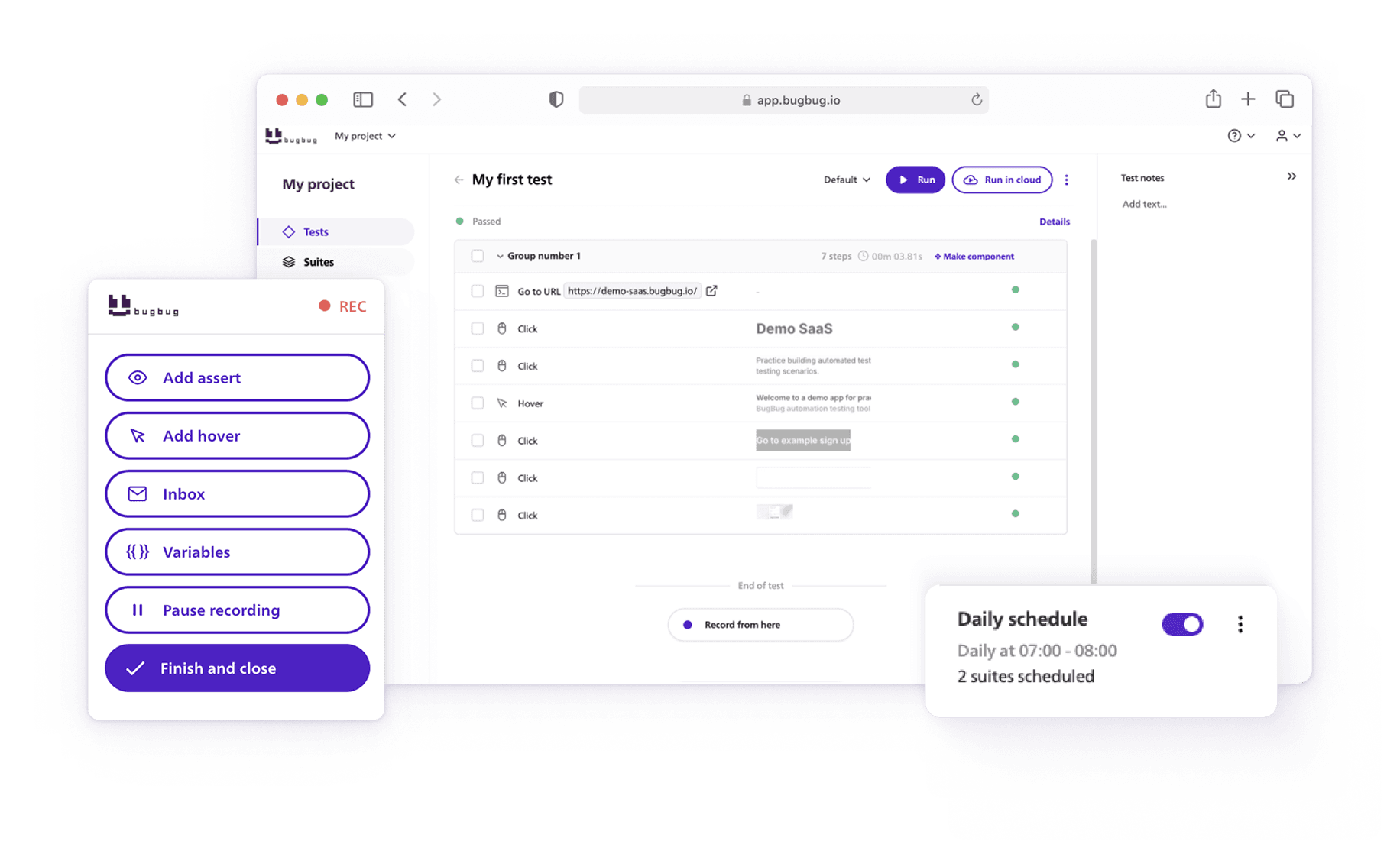
Try reliable automation with Bugbug
Test easier than ever with BugBug test recorder. Faster than coding. Free forever.
Get started
A Reality Check on Providers
Vendors approach AI testing very differently. Choosing the right AI testing company and QA partner with proprietary tools and specialized skills is crucial for ensuring reliable, accurate, and efficient validation of AI systems:
- BrowserStack focuses on AI agents layered onto massive real-device infrastructure.
- Qualitest Group is recognized as a leading AI-powered quality engineering company with a global presence, emphasizing “data scientists-in-test” for complex ML validation and handling unpredictable AI/ML systems.
- TestingXperts combines innovative AI testing with human intelligence to ensure quality, speed, and accuracy, and invests heavily in agentic AI and GenAI advisory.
- TestFort specializes in AI-enhanced testing solutions and has been delivering these since 2001, leveraging their experience to optimize AI model validation.
- BugRaptors offers AI and ML testing capabilities alongside other modern testing services, providing comprehensive solutions for evolving AI needs.
- Impact QA specializes in AI-driven testing with explicit offerings in AI/ML Testing and GenAI solutions, focusing on advanced automation and quality assurance.
- QA Mentor leverages a crowdsourcing platform with 12,000 testers globally for their AI-enabled testing services, ensuring broad coverage and diverse test scenarios.
- QASource focuses on AI ethics and security through specialized services like Red Teaming for AI systems, addressing critical concerns in AI deployment.
None of these replace the need for solid QE fundamentals.
The Bottom Line
Ultimately, AI testing services are a tool, not a requirement — and for many teams, they are simply not the most effective way to improve quality. AI does not automatically make testing faster, cheaper, or more reliable; in practice, it often introduces new layers of abstraction, cost, and risk that only pay off in very specific scenarios. If your primary goal is to automate stable web flows, maintain readable tests, and keep QA predictable under CI/CD pressure, tools like BugBug offer a different path: test automation that just works, without opaque AI decisions or hidden complexity. For many teams, especially startups and growing SaaS companies, disciplined automation, clear ownership, and deterministic tooling outperform AI-heavy approaches — not because AI is bad, but because it’s unnecessary. The smartest testing strategy is not the most advanced one, but the one that reliably fits your product, your team, and your real risks.